In this installment of Don’t Drive (Alone), we’ll look at how to get around (greenly) without a car. Expect some more fairly intuitive advice, here, folks!
How to get around without a car:
1. Public Transport
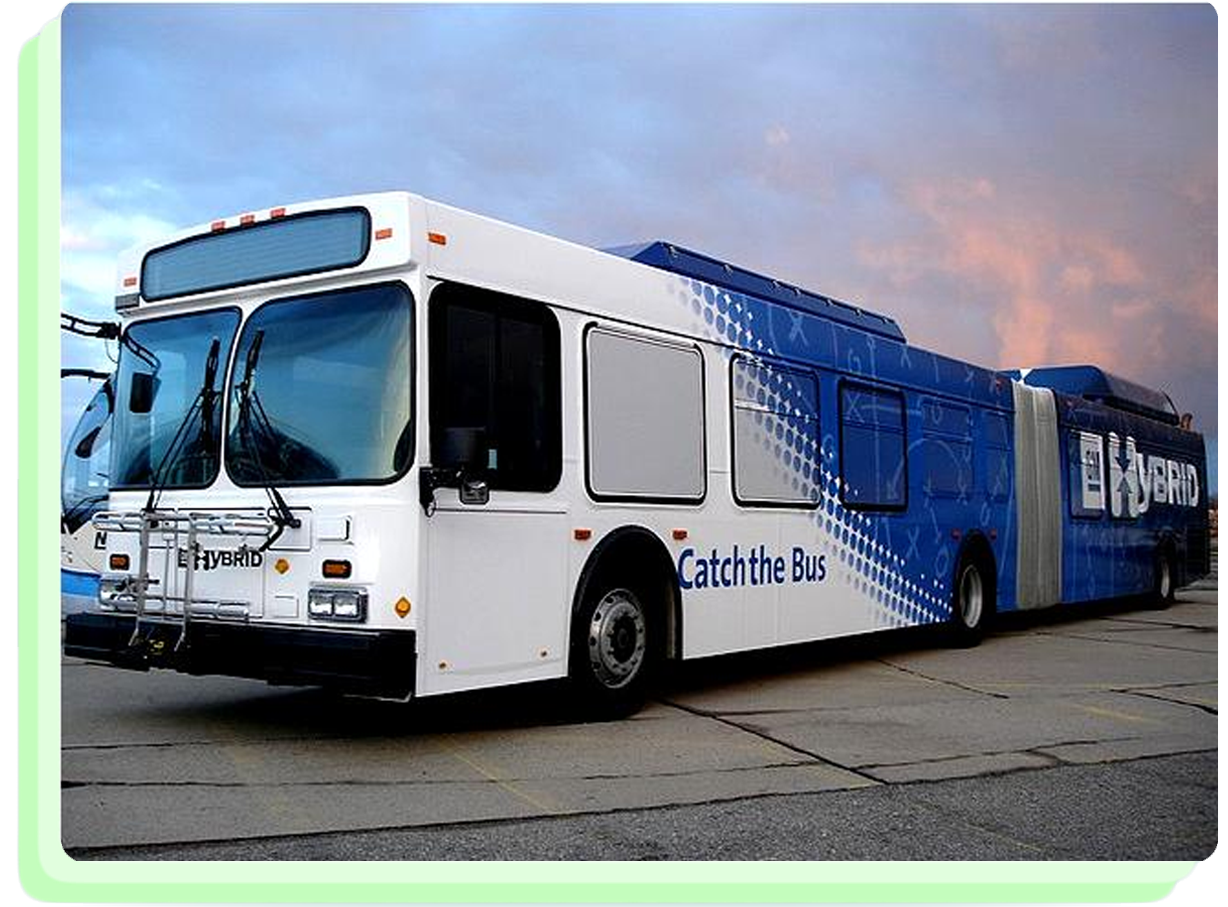
This is fairly self-explanatory. Many cities and towns have, at the very least, some sort of public bus system. Larger cities may also have a metro or light rail. Furthermore, some colleges have dedicated, free buses to get you around the campus. Educate yourself on what options are available where you live with a quick Google search, for example. Find out:
– Where you need to go. There will likely be more than one (bus) route, and it’s possible you might have to change lines to get to your final destination. Determine the closest stops to where you live and where you need to be and then see what your options are. If you have far to go, you may have to look in to long-distance options like Greyhound buses, shuttles, or trains.
– When you need to be there. Buses still have to deal with traffic but, unlike your car, you can’t control when they show up. Plan in extra time in case the bus is late or you miss a connection.
– Your budget. Public transport isn’t (usually) free. That said, it’s still usually cheaper than all the costs (fuel, maintenance, taxes, parking, etc.) associated with travelling by car. On some cases you can buy a ticket on the bus, on the spot. If you plan on using it regularly, however, it may be useful to see what methods of payment your local public transport company accepts. Some companies/organizations may offer discounts for frequent travelers or other deals, like a monthly pass.
The American Public Transport Association offers links to public transport options in every state, and even some other countries, here: Transit-Related Links
2. Walk
 Again, nothing profound here. If you can walk, do. It’s free and good for you. It improves cardiovascular health and reduces the risk of obesity. If the sun’s out, you’ll even get some natural vitamin D.
3. Bike (or skateboard/roller skate/unicycle)
Ok, so you can’t/don’t want to use mass transit, but you still need to get there quickly-ish. Grab something with wheels but no motor, then! Biking is a popular choice (and perhaps safer, since bikes generally come with more reliable brakes than skates or skateboards!), but anything will do. Hop on your ‘vehicle’ of choice and pedal your way. If you don’t have any, try checking the local Goodwill, Salvation Army, or Target, if you’re hoping to find something less than $100.

There is more inherent danger with this option as you may find yourself sharing the road with motorists. Remember these important points:
Be Safe
– Wear a helmet. Maybe you think it looks dorky, but a cracked skull looks even worse- and could be fatal. Furthermore, wearing a helmet is required by law, in many places. So get yourself a helmet and make sure it fits well.
– Don’t use earphones. It can get a bit monotonous on the road, but it’s important that you hear what is going on around you, be it a car coming up from behind that you didn’t see or someone honking/shouting for your attention. Some laws allow you to have one ear bud in, but weigh carefully your personal safety versus personal boredom.
Be visible
– Be visible. Wear bright colors. When biking at night, wear reflective materials, if you can, and:
– Use lights. Again, this is required by law in many places. You can generally pick up a pair of clip-on lights (a white headlight and a red taillight) fairly easily at a Walmart or Target, for example. In addition, make sure your bike has reflectors and a horn or bell.
Follow traffic rules
– Ride in the street. It’s generally frowned upon to use the sidewalk (unless you’re under 13, or your bike’s wheels are less than 26″ in diameter). Again, traffic regulations for non-motorized vehicles can depend on where you are. Do a quick internet search to find out what is tolerated and what isn’t where you live.
– Use the bike path. If there is a bike path or bike lane available, it’s safe, and you aren’t turning, use it. If there isn’t a path and/or there isn’t enough room for bike and car to use the lane side-by-side, you are allowed to bike in the middle of the lane. If there aren’t any safe paths available, you could go so far as to lobby your local government to increase spending on sidewalks and bike lanes.
– Ride with traffic. Go in the direction traffic is going, not against it. If you need to go the opposite direction, cross the street (at a designated crossing location) and ride with traffic there. A good rule of thumb is to behave the same way you would if you were driving a car. Being on a bike does not exempt you from the general rules of traffic, so:
– Obey traffic rules. Stop at all traffic lights and all stop signs. A lot of people seem to forget, or not know, this one. Even if no one is there, or you’re sure you could zip across fast enough that it wouldn’t bother anyone, don’t do it. Treat yourself like a very tiny, slow car. Not obeying posted traffic lights and signs is a crime, and you can be ticketed. And furthermore, you could get seriously hurt.
4. Rent a car
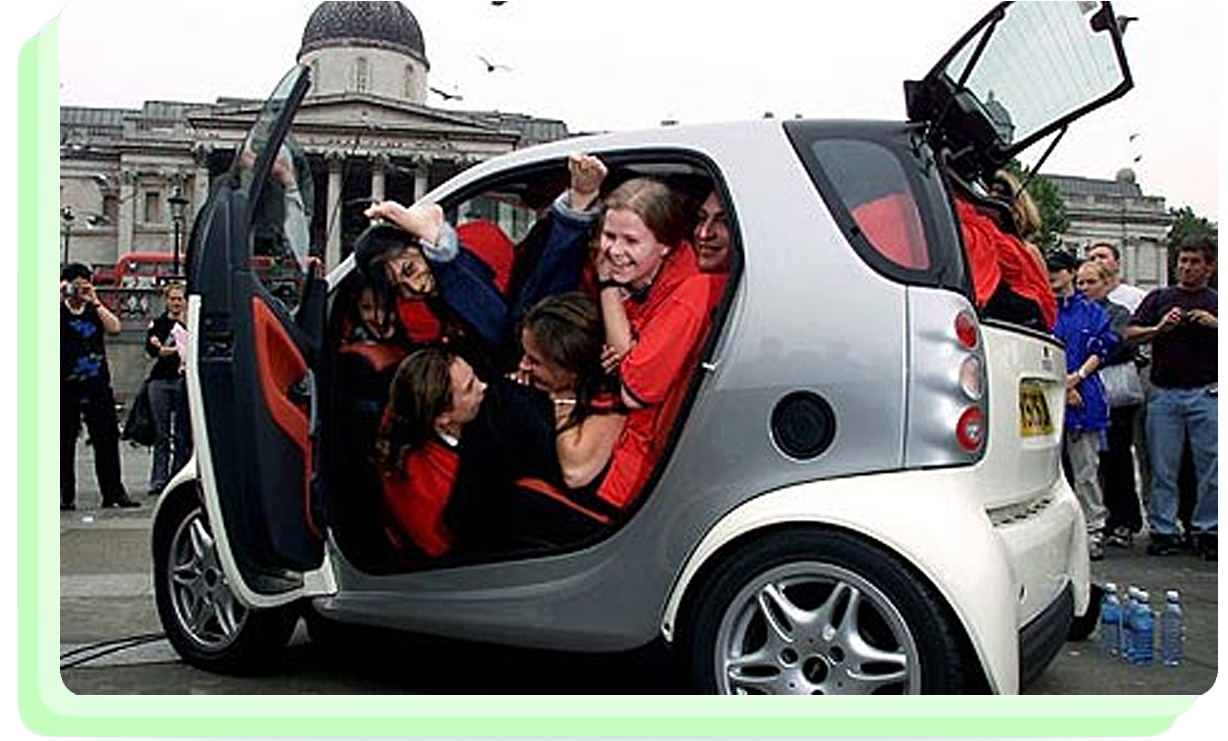 This might sound a bit counter-intuitive, what with the whole “cars = bad for the environment” thing mentioned in Part 1. However, if you are able to get around, for the most part, by other means (public transit, on foot, by bike, by carpool) and need only rent a car for short periods every now and then… renting a car from time to time is certainly a environmentally friendlier (and cheaper!) compromise than owning a car. There are a few different types of car sharing schemes out there:
– Peer to Peer. This is where the marketplace matches drivers to cars available to rent from a fleet of cars owned by the community. A few Peer to Peer groups include:
+ Whipcar
– Business to Consumer. This is when a company owns the fleet of vehicles and manages the car-sharing among members. A few car-sharing companies include:
+ Zipcar
+ StattAuto (Germany)
+ GoGet (Australia)
– Not for Profit/Co-Op. When local communities or organizations facilitate car sharing in order to try and change peoples’ driving habits rather than to make a profit. A few such organizations are:
+ City Car Share (San Francisco area, CA, USA)
+ I-GO Chicago (Chicago area, IL, USA)
Be sure to do a search of your own and see what is available in your area. Or even better, start one.
If you missed out on the previous installment, see how to get around with a car in Don’t Drive Alone – Part 1.
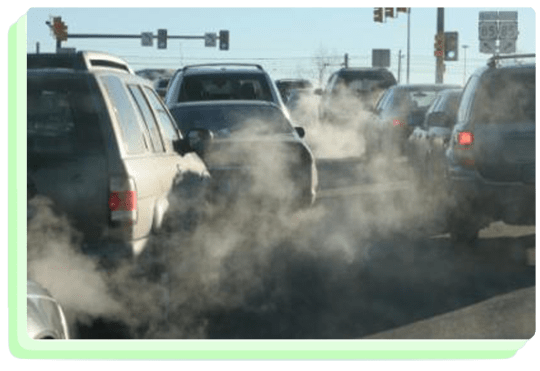
This might seem like a no-brainer. Maybe you’ve heard it all before. Bear with me. Cars consume fossil fuels and produce pollution. So don’t use them, right? Well, easier said than done! Not that things worth doing are usually easy… Maybe you don’t even have a car! Well, don’t worry. In this post I’ll try to cover how you should drive, if you have to, and how to get around without a car, if you don’t!
How to get around with a car:
1. Carpool/Ride share
So, let’s say you do need to go somewhere in a car. Maybe you’re in a rush, maybe it’s all the way across town/the state/the country, and there’s no good public transport access. Whatever the reason, you need to go by car. If that’s the case, then consider doing a carpool. See if anyone needs to go in the same direction as you, and then take them along. Or, if you don’t have a car, see if they’ll take you along. If you have to go somewhere on a daily/regular basis, like work or school, see if there are a few people with the same shift/classes and go all together. If more than one of you has a car, you can take turns being the driver so its not always the same person who has to leave early to pick up the others.
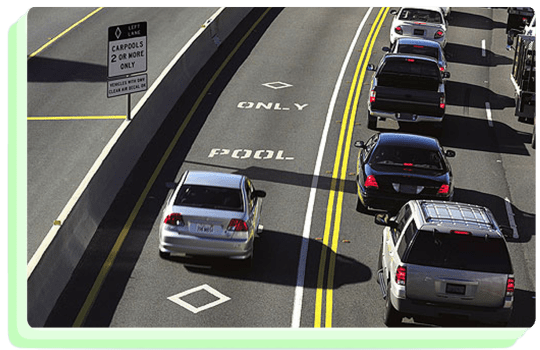 Plus, you get to drive in the (usually) less-cramped HOV lane!
Furthermore, many Universities offer ride-share programs. When I was studying at NAU there was a board outside the cafeteria where people could post when and where they were/needed to go somewhere. This helped students get in to contact with each other, whereas they might otherwise never have met.
Long story short, if you’re driving somewhere, try to get as many people in your car as you can. Split the carbon cost and, hey, maybe the gas money, too!
Here are a few sites where you can look for carpool groups near you (I cannot personally vouch for them, however):
– Ridejoy
2. Drive efficiently (hypermiling)
There are a few things to be said for this tip. The less fuel you use, the better- for your wallet and the environment. A few ways to increase your miles per gallon include:
-Don’t be a leadfoot. This is the essence of ‘hypermiling’, in its most basic form (2). Use the gas pedal (and the brake) as little as possible. Every time you use the gas pedal you are consuming fuel and, by the same logic, you are throwing that fuel away every time you use the brake. Coast as much as possible; don’t ‘jack rabbit’ start off the line when the light turns green, and don’t screech to a stop when it turns red. Be aware of your surroundings, and drive accordingly. For a full description of what hypermiling is, check out this article here: Hypermiling: Driving Tricks Stretch Miles Per Gallon.
– Slow down. This is another no-brainer. I know we usually want to get where we’re going as quickly as possible, but Speeding Doesn’t Get You There Faster. The faster you go, the more fuel it takes to keep you going that fast- and the more fuel you’ll have to spend to get back up to that speed, if you have to slow down or stop. It’s a speed limit, not a speed requirement, after all. Besides, it’s not just safe, it’s smart: once you drive faster than 55mph, your fuel efficiency drops up to 15% (1).
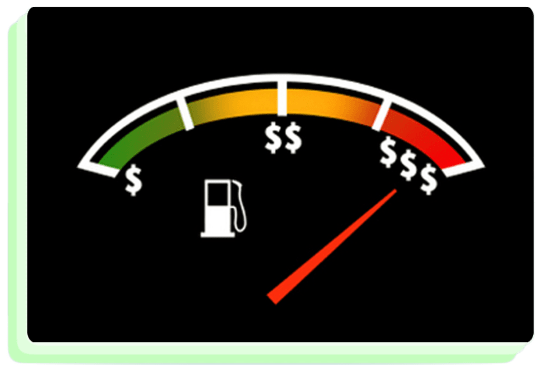 In other words.
3. Use low grade fuel
Lower octane fuel requires less fossil fuel to produce (1). It’s true, higher octane fuel helps reduce engine knock- if your engine was made before the 1980’s (4). If your care is newer than that, it’s probably designed to run on fuel with an octane rating of 87. You can find out by checking your car’s owner manual. Some higher performance engines do need higher octane fuel, but using fuel with too high an octane rating otherwise can damage a car’s emission systems. If you can afford such a high performance car, you can afford an ‘eco’, hybrid type car, instead.
4. Don’t idle
Don’t idle, or idle as little as possible. Idling for 20 seconds burns more gas (and emits more carbon dioxide, or CO2) than simply turning the car off and back on again 20 seconds later (1). If you’re at a long stop- at a train crossing, for instance -consider turning off the car. Furthermore, turn off your engine when parked. I know it might be tempting, if you have to wait while parked somewhere, to crank up the A/C or radio, but consider parking in the shade and opening the car door instead, and bringing an MP3 player. Or a book. Ix-nay on the idling.
5. Don’t make special trips for gas
We’ll finish with another no-brainer, here. Just as it says- don’t make a special trip just go get gas. Then you’re just spending gas… to get more gas. Try to work filling up in to the rest of your schedule- tank on the way to or from work, school, or the supermarket, from example.
6. Bring a bike
If you’re heading in to town/school/somewhere you plan on maybe doing a lot of different errands in a small area, but far from home- bring a bike. Or, if it’s going to be a regular occurrence (like driving in to town for work or school), invest in a good lock and leave your bike somewhere you can easily access it when you need it. When I went to university, the campus was very long and thin- and I often had a class on the south end right after a class on the north end, and only 15 minutes to get from one to the other. It make little sense to pay for parking permits for multiple different lots- that would be expensive, obviously not environmentally friendly, and possibly still make me late since traffic was always congested on campus. So, I got a permit for the lot in the middle of campus and locked up my bike outside, or took it home in the car when I knew I’d need it closer to home. Naturally, you can also bring a skateboard, roller skates, unicycle, or scooter, as you prefer.
Coming up… Don’t Drive (Alone) – Part 2
In the next installment, I’ll discuss how to get around without a car! Stay tuned.
(1) http://www.wikihow.com/Drive-Green
(2) http://www.livescience.com/5031-hypermiling-driving-tricks-stretch-miles-gallon.html
(3) http://www.projectthinkery.com/2011/07/speeding-doesnt-get-you-there-faster.html
(4) http://chemistry.about.com/od/chemistryarticles/a/which-gasoline-to-buy.htm
My name is Kathryn Hannis.

I’m originally from Arizona in the United States and I completed my Bachelor’s degree in Environmental Engineering there at Northern Arizona University in Flagstaff in 2010. After that, I moved to The Hague, The Netherlands, in Europe to do a Master’s degree in Sustainable Energy Technology at the Technical University of Delft, which I completed in March of this year. Ever since I embarked on that first environmental degree back in 2006, I toyed with the idea of starting a blog or website compiling ideas of how to ‘be green’ as a student living in an apartment or a dorm on a limited income. It seemed only appropriate, given the subject of my study, that I start practicing sustainable living at home, as well. Naturally, putting solar panels on the roof or anything quite that extravagant was out of the picture, so it was time to do some research. And why not share that with the public? Well, it’s taken some time, but I’m finally getting started.
I was reminded of this idea recently when my mother suggested starting a blog as ‘something to do’ on the side, while looking for a job, to prove I wasn’t just sitting around on my hands all day. It wasn’t until she told me about her own recent personal experience that I really got around to it, however. She works as a typist, editing the format, among other things, of documents for an international organization. Recently, she received two separate documents which contained documents with tables detailing information for various countries. One page for each country. The documents were over (or nearly) 100 pages, each. Which some clever formatting, my mother was able to fit the tables and data on to 10 pages or less, in both cases. In one print run, she would have saved the organization over 60,000 pages. That’s a small tree‘s worth (1). If they had gone with her edit. You see, they didn’t. Too difficult and/or too late to get permission. Next time, they said. Easier to ask forgiveness cut down one tree than to ask permission, apparently.
Well, that really set my blood boiling in impotent rage. They aren’t currently hiring a sustainability adviser at this organization, so what else could I do? Start this blog, finally, and help those who are willing to listen and want to start going green. Let’s go together, shall we?

 Green Start